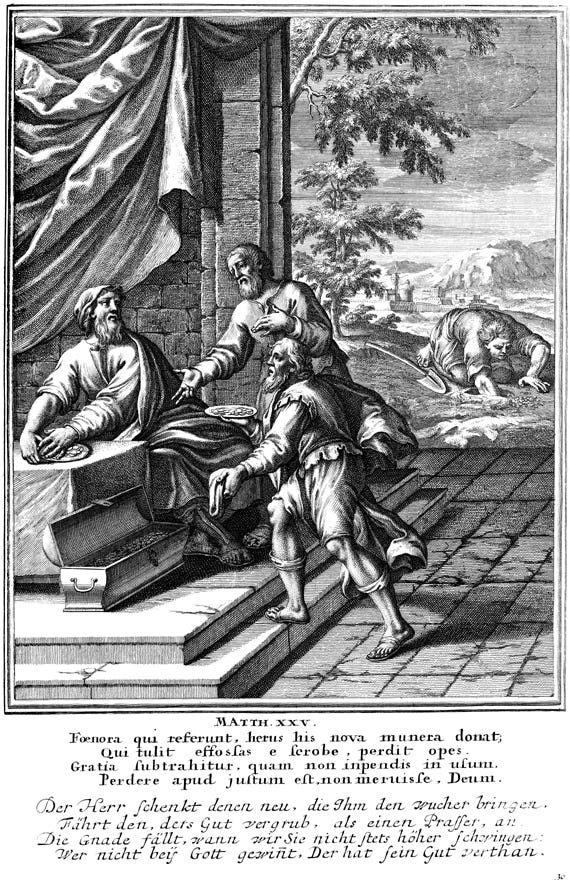
Whose talent?
A Sermon for Proper A28

I wrote and presented this sermon in my Intro to Preaching class this second semester of seminary, and I decided to share it with you. It has been edited since first presentation, based on the feedback I received from my professor and classmates.
Read the Scripture lessons here. I prefer Track 2, in this case, but it is the same Gospel in both.
The Gospel for today begins, “For it is as if…” Which is a little confusing if we don’t know what came before, what Jesus is referencing. Well, if you go all the way back to the previous chapter, you’ll find that Jesus is describing, at some length, the nature of his coming. To the utter horror of the disciples, he would not take up arms against the occupying Roman legions, he would not liberate and restore the religio-political Kingdom of Israel. In fact their Messiah would die, and they would follow close behind. The Temple, the focal point of Jewish peoplehood and worship, would be destroyed.
In a series of fables that feel more like riddles, Jesus exhorts his disciples to be alert and resist complacency, for he is coming soon, like a thief in the night. Soon after the Ascension, sure enough, Jesus “returns,” in a sense, to receive each one of them as an oblation, a sacrifice—in death. When we read the Parable of the Talents, it is not a mere cautionary tale, a simple warning against envy. It is not fodder for an argument that poor and stupid people deserve to get poorer while the clever rich get richer. It is not an indictment in the opposite direction, either, a prooftext for the so-called “Social Gospel,” laying all the responsibility for the ills in our society on the rich.
Despite the layered and mysterious nature of the literary genius that is the Parable, the point is rather straightforward, and it is the same today as it ever was:
Your world is about to end,
you are going to die for your faith,
here is what you must do.
And if you don’t think this applies to you - here - today, I’m not sure what planet you are living on. This is what is happening.
Now let’s back up for even more context. This Parable of the Talents is not unique to Jesus. Like other m’shalim, other parables, it is somewhat canned and multivalent, a Jewish storytelling device. There are standard forms of the mashal that can mean a lot of different things with just a little adjustment; this one just happens to be employed not only as pedagogy, but also as prophecy. This is what is coming, Jesus says, be ready.
The source material for this parable is probably a common ancestor of both the Gospel of Matthew and one of the earliest pieces of rabbinic literature preserved in the Mishnah—the teaching of Rabbi Tarfon:
“The day is short, but the work is long; the workers are lazy, but the reward is great; and the Master of the House is knocking.” knock, knock, knock
Can you hear it? The knocking? Can you feel the sudden anxiety evoked by the pattern of the parable? There is so much to do, not enough time to do it, and I really don’t want to do the work anyway, despite the promises attached. And now, what was that sound? The Boss is here for an inspection.
I would say, “Lord have mercy,” but the Lord is the one who devised this system and assigned our roles. Does this feel like good news? It is, I promise—we will get there.
Quick historical trivia question, how much is a talent?
Generally a unit of measure for gold or silver, the Judean talent in the Second Temple period was one hundred and thirty pounds. That is at least seventy-four thousand dollars if silver, and upwards of five million USD on the current gold market, and here is the first part of the good news: The Master has given the slaves quite a pretty penny. Even the one who receives the least has been given very much, and the disciples would have known this when Jesus told them the parable.
The bad news, or so it seems, is that none of the slaves actually own their talents—they all belong to the Master. And so all are truly equal in their poverty, mere agents for the one who owns them, that is, the slaves themselves. What the Master offers is not so much a range of riches, but a range of opportunities, all of which are actually quite good, but none of which are anyone’s private property.
When the Master returns, what does he say to the single-talent servant? The one who buried his five million in the dust?
“To all those who have, more will be given, and they will have an abundance, but from those who have nothing, even what they have will be taken away. As for this worthless slave, throw him into the outer darkness, where there will be weeping and gnashing of teeth.”
From those who have nothing? Nothing? You gave him seventy-four thousand dollars, at the very least! How on earth can this slave be said to have nothing? Rabbi Tarfon is once again helpful if we compare our gospel with his next teaching. Once again he says:
“The day is short…the work is long…the workers are lazy…and the Master of the House is knocking,” knock knock knock
AND, the Mishnah adds:
“[Rabbi Tarfon also] used to say: It is not on you to finish the work, neither are you free to neglect it. If you learn much Torah, you will receive a great reward. The Master of your work is trustworthy to pay you the reward for your works. Know that the gift of the reward of the saints is in the time to come” (my translation, for both mishnayot, see Pirqei Avot, 2:15-16).
Matthew is not exactly missing something from the end of the Parable of the Talents, but Rabbi Tarfon certainly seems to supply useful instruction for understanding it: The second part of the good news is that the Master is trustworthy, and this is what the poor slave has missed. God, he thinks, will reward him according to his works, and he’s right. Sorry, fellow Protestants, but if you take Jesus seriously, if you take Paul seriously, if you take parallel literature seriously, then it is abundantly clear that God will reward us according to our works in “the time to come.”
So then what is the slave’s complaint?
The Master has not leant him the same amount as his peers. The Master was by no means stingy with the slave, but he was more generous with the others. The wicked slave is jealous, and wouldn’t you be too?
The slave has forgotten that the Master was with him the whole time, true to his word. He has forgotten that the talent given was not only sufficient, not merely abundant, but excessive for the task at hand. He has forgotten that he never owned the talent in the first place, it was only leant to him for the task at hand.
I talked a lot about the slave today, but don’t think you’re off the hook. Here are my questions for you:
Do you know that the Master is with you?
Do you know that what you have been given by God is sufficient, with a little investment, for the purpose to which the Lord calls you?
And do you understand that everything you have—your wealth, health, and happiness, your very body and soul—was never yours in the first place, but is the sacred holding of the Most High God?
Today we are in a turning of the age much like the time of the Apostles in great and many ways. What was once assumed invincible is crumbling, the bonds of social order are falling apart, every sacred cow or high temple on a hill will fall, not one stone left upon another.
If you want to follow Jesus, and there is no better choice, this is what you must know: you can trust God. You can trust God! More than you can trust any human being, more than you can trust me, more than you can trust the church, and more than you can trust in your government to have your best interest at heart, you can trust Jesus who provides whatever pounds of silver you think you own. You can trust the Spirit that guides you all of your investments for God’s purposes. You can trust, even if you are led to suffer or die for your faith, that you will only be suffering with and for Jesus, and here is more good news: the Lord takes nothing back which he did not give in the first place.
Against the din of our loud, vain, and individualistic culture, it is difficult to hear, but it does not make it any less true: you are not your own. And this is good news, because no one else may own you either. You do not belong to this world, you do not belong to any other man, you belong to Trustworthy Jesus, and there is no greater end than this.